
Questions
Short answers.
No slogans.
How the analysis works, what a path actually is, what it costs to plan for, and what we will not promise.
FAQ
The Drainage Analysis
The first visit is the product. We do not spend field days on free opinions.
Why is the first visit a paid Drainage Analysis?
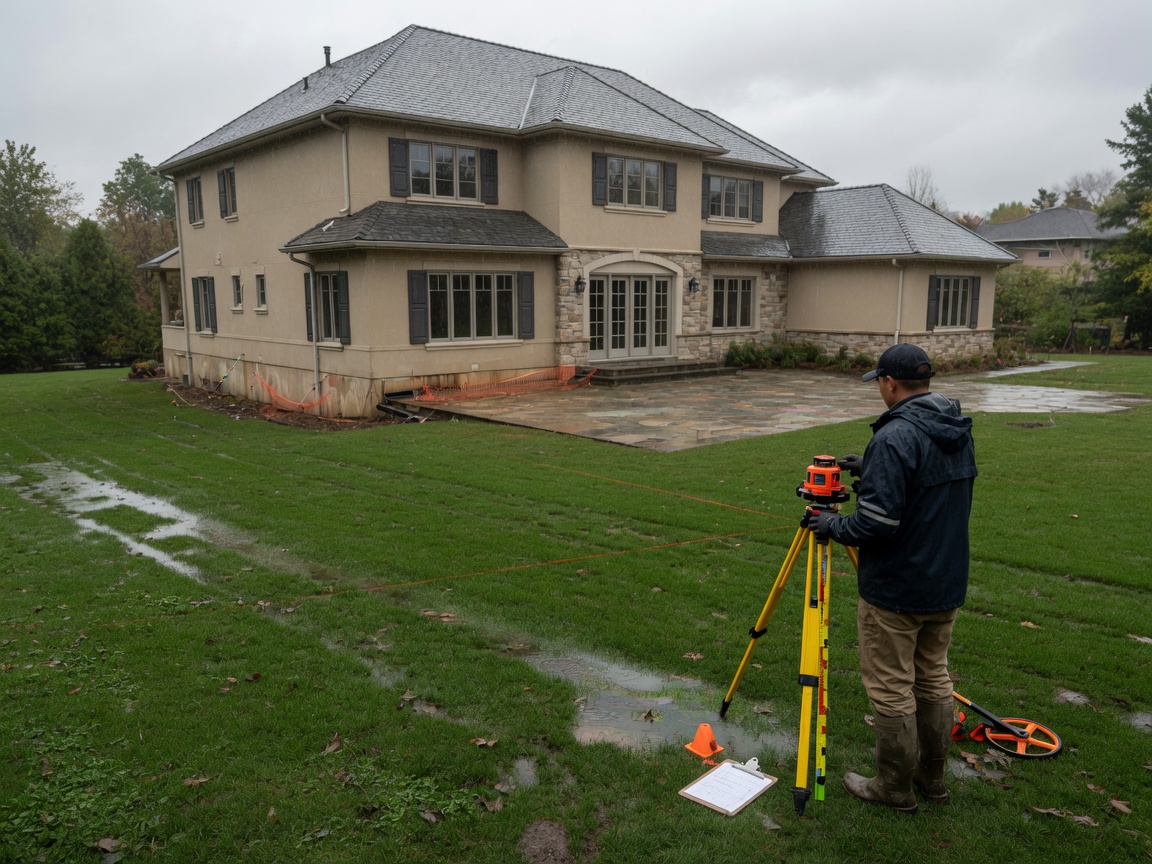
Every property is different. Free “estimates” turn into unpaid field days and a sales pitch for the product the crew already knows how to install. The analysis is the product: walkthrough, sources, elevations, downspouts, irrigation leak screening, collection and discharge planning, a preliminary diagram, and a written proposal. The fee is credited toward an approved installation.
What does the analysis include?
Property walkthrough, water-source identification, elevation measurements, drainage and downspout review, irrigation leak screening, collection-point planning, discharge planning, a recommended system, a preliminary system diagram, and an installation proposal.
What does the analysis cost?
The starting test price is $249–$495, credited toward an approved installation. That is a planning band, not a forever menu. Complex or commercial lots can be scoped differently.
Can you quote me from photos?
Photos and a short video of the water moving help triage. They do not replace elevations, a legal discharge, or a walk of the lot. We will not sell a system from a selfie.
What should I do before the specialist arrives?
After a rain, note where water sits the next afternoon, whether the irrigation ran, and where downspouts dump. Clear access to the side yard and the wet area. Do not open a weekend trench in clay before the visit.
What if you decide it is not a drainage job?
Then we say so. A pressurized irrigation leak, a sewer backup, or a municipal overflow is not solved by pipe in the lawn. The analysis exists to separate those causes before anyone digs.
FAQ
WaterPath™ and how we work
We do not guess and start digging. The process is the product.
Do you always install a French drain?
No. A French drain is one collection method. Some lots need grade. Some need a channel at the driveway. Some need a pump because there is no gravity fall. We identify the source, the collection, the conveyance, and the discharge before anyone digs.
What is the WaterPath process?
Source, capture, move, discharge, restore, verify. Where is the water coming from, where should it be collected, how should it travel, where can it legally leave, how is the property put back, and can we prove the path works. Read the full sequence on How It Works.
What does “verify” mean?
A flow test, recorded elevations and slope, photographs of the open trench and the finish, and an as-built drawing the owner keeps. If it cannot be shown, it was not finished.
Will this stop all flooding?
No responsible drainage company promises that. We design for the sources we can identify and the rainfall and site conditions written in the scope. Extreme events, neighbor discharge, and municipal systems can exceed any residential installation.
Do you promise to protect the foundation permanently?
No. We will not write that sentence. We can move identified water off the wall and document the path. Foundations, soils, and storms are larger than any residential trench.
How is this different from a landscaper who “does drains”?
Sequence. We measure grade, separate sources, specify perforated versus solid pipe, and write a discharge before the first cut. A trench that “should soak in over there” is not a system.
FAQ
The wet yard
Match the water you have — not the product on the truck.
Why is my yard still wet the day after it rains?
The lot is collecting water faster than it can leave. That can be a bowl in the grade, a downspout feeding the low spot, compacted fill, clay that will not percolate, or a missing discharge. Standing water is a path problem — not automatic proof you need a French drain.
The side yard is always mud. Is that a drain?
Often. The corridor between the house and the fence is a trap: roof water, no daylight, and shade. Sometimes the first move is burying the downspouts. Sometimes it is a collection line and solid pipe through the corridor. We measure both structures before we pick.
Water sits against the foundation. How urgent is that?
Water on the wall is a property-risk problem, not a backyard puddle. Stop feeding the foundation first — downspouts, beds piled against brick, grade that pitches to the slab. Perimeter collection comes after the sources are named. We do not promise to protect a foundation permanently.
The driveway sends storms into the garage. What actually stops that?
A channel drain at the right elevation, then a conveyance line that leaves the property. The drive is pitching toward the door. Towels and a longer downspout will not change the slab.
Could this just be a sprinkler leak?
Yes. Wet when the irrigation runs, dry after rain, or a single zone that never dries is often a pressurized line — not poor drainage. We screen for that on the analysis. Installing pipe to “fix” a leak leaves the leak in the ground.
The backyard disappears after a storm. Is that one basin?
Sometimes a single low area is a yard drain. Often the whole rear lot is a bowl — fill, fences, and neighbor discharge with nowhere to go. That can be grade, collection, a pump, or a whole-property path. The analysis is how we tell which.
Soil and mulch keep washing out. Do I need more plants?
If the soil is moving, the water already has a path — just not one you chose. Planting on top of concentrated flow is how the bed disappears a second time. We slow it, collect it, or give it a designed swale and an outlet.
Which of these is a Drainage Pro job versus someone else?
Wet only after rain belongs here. Wet when the sprinklers operate is irrigation. Sewage odor or fixtures backing up is a drain line. If you cannot tell, book the analysis before anyone digs.
FAQ
Systems and products
Tools. Not nicknames for the same ditch.
What is the difference between a French drain and a yard drain?
A French drain collects subsurface water in a trench — perforated pipe, washed stone, fabric. A yard drain or catch basin collects surface water at a grate. Saturated soil that never dries wants collection below grade. A visible pond at a low point wants a grate at the true elevation.
When do you use a channel drain?
When stormwater travels as a sheet — driveway, garage apron, patio, pool deck. The channel intercepts. A conveyance line still has to leave the property. Setting the channel to the slab is the job. Guessing the height is how water goes under it.
When is grading enough?
When the lot pitches the wrong way and there is room to restore fall without a pipe. A swale is a designed depression. Re-grading fails if someone just adds dirt without measuring start and end elevations.
When do you need a pump?
When the lot has no gravity fall to a legal discharge. Flat Gulf Coast and many filled pads are in this group. A pump without a designed outlet is a wet hole with a motor in it.
Solid pipe or perforated?
Perforated collects. Solid conveys. Roof water belongs in solid pipe so it does not recharge the soil you are trying to dry. Mixing the two is a common failure.
Where does the water exit?
Daylight, a pop-up emitter, an approved storm connection, or a pump — never the neighbor’s yard. “It should soak in over there” is not a discharge. We write the outlet into the scope before anyone digs.
Will you restore the lawn?
Yes. Restoration is part of the path: sod, beds, hardscape we cut, irrigation we crossed. A correct drain under a wrecked lawn is half a job. The grate should be the only thing you see.
FAQ
Cost, time, and scheduling
Planning bands, not a menu called French drain.
What does a typical project cost?
It depends on trench length, soil, access, pumps, discharge distance, and restoration. Planning ranges we test: localized correction around $1,500–$3,500, core installations around $3,500–$9,000, and whole-yard or complex systems $9,000–$25,000+. Commercial and multifamily work is scoped separately. None of those is a quote until the path is drawn.
Is the analysis fee credited?
Yes, toward an approved installation. It is not a coupon for a product you do not need.
How long does installation take?
A localized correction can be a day. A core system is often a few days. Whole-property work, pumps, or hardscape cuts take longer. Soil, access, 811, and weather set the calendar — not a slogan.
Do you work after a major storm?
Demand spikes when the problem is visible. We still will not skip the analysis to win the week. The first trench has to be the right one.
Do you offer financing?
Financing relationships are part of the central offer when they are in place for that market. Ask on the analysis. Do not assume a rate from this website.
FAQ
811, permits, neighbors
Outdoor drainage is not unregulated.
Do you handle permits and 811?
Utility locates are required before digging, even in a backyard. The 811 ticket number belongs in the job file. Storm connections, easements, floodplain work, and right-of-way discharge are flagged on intake. Local rules differ by city.
What if the water comes from my neighbor?
Uphill discharge is a source, not a personality conflict. We can intercept it on your lot. We will not design a system that dumps onto theirs. Easements and shared lines get named on the analysis.
What if the trench crosses sprinkler lines?
That portion belongs with a licensed irrigator. We do not pretend a drainage crew is an irrigator. Irrigation leak screening is also part of the analysis so we do not install pipe to “fix” a pressurized leak.
Are you allowed to connect to the city’s storm system?
Sometimes, with approval. Sometimes not. We will not guess a connection into the right-of-way and call it done. That question is on intake.
Is the property in a floodplain?
Tell us. A residential system will not repeal a floodplain. We design for identified sources, not for the river.
FAQ
After the install
The file is part of the job.
What do I receive when the job is done?
A clear scope, the as-built, photographs, and a record of elevations, pipe type, discharge, and the flow test. You should know where the cleanouts are.
How do I maintain the system?
Pull grates. Keep leaves out of basins. Confirm the discharge is still visible after landscaping. After the first heavy storm, look. The as-built tells you where to look.
What should I watch in the first storm?
The grate, the discharge, and the wall. Photograph. Compare to the drawing. Call if the water does not follow the plan. That is verification, not a complaint.
What if new landscaping changes the grade later?
Beds, walls, and added soil move the low point. Yesterday’s path can die under six inches of good intentions. Walk the lot after the first rain on the new work.
FAQ
The company
A national process. A local crew. Not a lead mill.
Who actually does the work?
Drainage Pro owns the brand, the process, the analysis standard, and the customer communication. Local drainage, excavation, or landscape businesses install under that standard — elevations, pipe spec, discharge, photographs, flow test, as-built. You are not buying a lead. You are buying a designed path.
Where do you work?
Operating markets are listed on Locations. Enter a ZIP. If we are not there yet, we will say so. We do not invent coverage.
Do you sell franchises?
Territory relationships for qualified drainage and excavation businesses are discussed separately. We do not treat the homeowner site as a franchise advertisement. If you operate a capable company, use Territory Opportunities. Counsel reviews any branded territory relationship.
How is this different from SprinklerRepair or a drain-cleaning company?
Wet only after rain belongs here. Wet when sprinklers operate is irrigation. Sewage odor or fixtures backing up is a drain line. The websites stay separate so the homeowner is not sold the wrong trade.
Still looking
Start with the water.
If the answer depends on your lot, that is the analysis — not another paragraph.