Six moves. One path.
-
01
Source
Where is the water coming from?
Most failed drainage jobs start here — someone sold a product before they named the water. A wet side yard can be a downspout, a broken irrigation lateral, a neighbor’s discharge, perched groundwater, or a lot that pitches toward the house. Those are five different paths. They do not share a trench.
- Roof and gutter volume at each corner
- Irrigation that stays wet when it is not raining
- Uphill lots and neighbor outlets
- Driveway sheet flow to the garage
- Soil that stays saturated after the surface dries
We do not walk the yard, point at a puddle, and call it a French drain.
↓
-
02
Capture
Where should it be collected?
Capture is a decision about elevation. The grate, channel, swale, or perforated line has to sit where the water already wants to go — or the grade has to be changed so that it does. Collecting three feet off the low point is how you install a drain that never sees the storm.
- True low points, measured, not guessed from the porch
- Surface versus subsurface collection
- Whether grade alone can do the work
- Keeping roof water out of a soil-collection line
A basin in “the wet spot” with no fall and no outlet is not capture. It is a hole.
↓
-
03
Move
How should it travel?
Once water is collected it has to travel. Solid pipe carries it. Perforated pipe collects it. Mixing the two is how a system recharges the lawn you just tried to dry. We specify diameter from volume and length, set a recorded slope, and put cleanouts where a future crew can actually reach a blockage.
- Perforated versus solid by zone
- Pipe diameter and recorded fall
- Cleanout locations
- Crossing the lot without wetting it again
We do not run corrugated pipe downhill “until it feels right.”
↓
-
04
Discharge
Where can it safely exit?
Every system ends somewhere. If that somewhere is illegal, uphill, or the neighbor’s fence line, the job is not finished — it is relocated. Flat lots often have no gravity fall. That is a pump conversation, not a longer trench. We write the discharge into the scope before anyone digs.
- Daylight with real fall
- Pop-up emitters that will not drown a bed
- Lawful storm connections
- Pumps when gravity will not serve
- Easements, floodplain, and right-of-way
“It should soak in over there” is not a discharge.
↓
-
05
Restore
Make the property look right again.
The property should look like a finished home, not a jobsite. Restoration is part of the path: sod, beds, concrete or pavers we cut, and irrigation we crossed. A correct drain under a wrecked lawn is only half a job. The homeowner should see grass and a grate — not a scar.
- Sod or seed matched to the lawn
- Beds and edges put back
- Hardscape cuts closed
- Irrigation repairs by the right license when lines are crossed
We do not leave a trench and call the rain “settling.”
↓
-
06
Verify
Can we prove the path works?
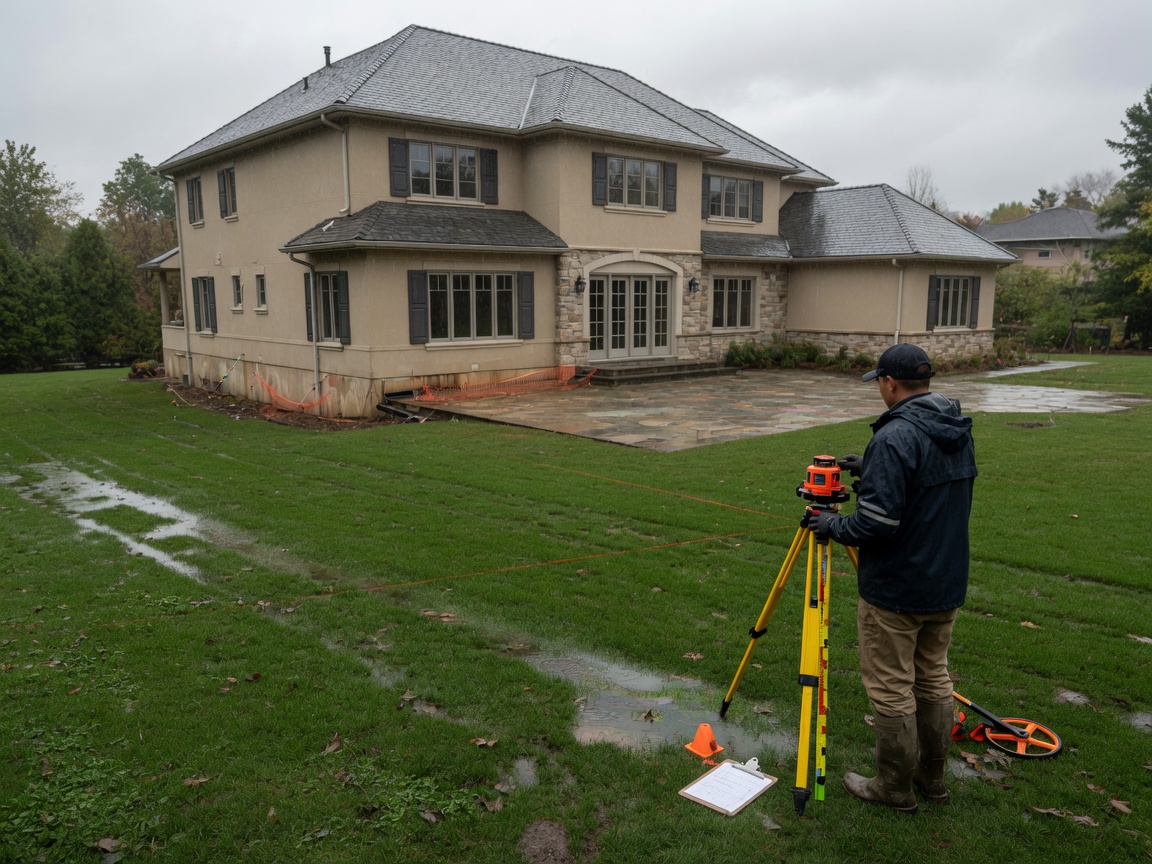
The sixth move is the reason WaterPath is not a slogan. Starting and ending elevations. Intended pipe slope. Pipe type. Discharge point. Before, progress, and after photographs. A flow test. An as-built for the owner. The scope says what rainfall and site conditions the system was designed to manage. We do not promise to prevent all flooding.
- Recorded elevations and slope
- Flow test at handover
- Photo record of the open trench and the finish
- As-built drawing the owner keeps
If it cannot be shown, it was not finished.